
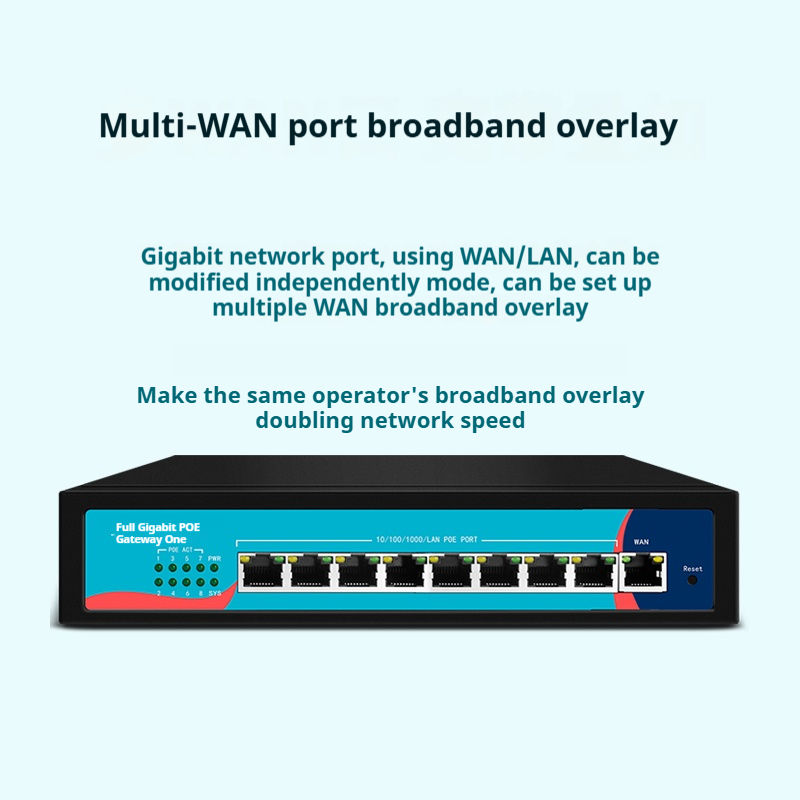
With the rapid development of the Internet of Things (IoT) and smart networks, more and more network devices (such as wireless APs, IP cameras, and VoIP phones) need to be deployed in various scenarios. However, the traditional deployment method that requires separate data cables and power cables not only increases the difficulty and cost of wiring but also affects the beauty of the environment and brings inconvenience to later maintenance. As a new type of network device, POE+ Gateway solves this problem perfectly by integrating data transmission and power supply into a single network cable, simplifying network deployment and improving operation efficiency. This article will elaborate on the working principle, advantages, application scenarios, and selection points of POE+ Gateway.
POE+ Gateway, also known as Power over Ethernet Plus Gateway, is an upgraded version of the traditional POE gateway, complying with the IEEE 802.3at standard, which can provide higher power supply (up to 30W) while transmitting data. Its core principle is to use Power over Ethernet (PoE) technology to transmit both data and electric power through a single twisted-pair Ethernet cable, eliminating the need for separate power cables and power sockets for terminal devices. The POE+ Gateway acts as a power sourcing equipment (PSE), which detects the powered device (PD) connected to it (such as a wireless AP, IP camera) through a 25kΩ resistor, and then provides appropriate power according to the power demand of the PD, while transmitting data synchronously.
Compared with the traditional separate wiring method and ordinary POE gateway, POE+ Gateway has obvious advantages. First, it simplifies wiring: a single network cable can realize both data transmission and power supply, reducing the number of cables, construction time, and wiring cost, especially suitable for scenarios where wiring is difficult (such as suspended ceilings, walls, and outdoor areas). Second, it provides higher power: the power supply capacity of POE+ (30W) is higher than that of ordinary POE (15.4W), which can support high-power terminal devices such as high-definition IP cameras, dual-band wireless APs, and VoIP phones, meeting more diverse device needs. Third, it is safe and reliable: it adopts overcurrent, overvoltage, and short-circuit protection technologies, which can automatically cut off the power supply when the device fails, protecting the terminal device and the gateway itself. Fourth, it is easy to manage: it can centrally manage the power supply and data transmission of multiple terminal devices, and support remote monitoring of the power status and working status of the device, reducing later maintenance costs.
The application scenarios of POE+ Gateway are mainly concentrated in scenarios that require a large number of network devices and difficult wiring. In smart buildings and office buildings, POE+ Gateway supplies power and transmits data to wireless APs, IP cameras, and access control devices through a single network cable, realizing intelligent management of the building and simplifying the wiring of the entire building. In security monitoring systems, POE+ Gateway connects multiple high-definition IP cameras, providing stable power supply and data transmission, avoiding the trouble of separate power supply for each camera, and improving the stability of the monitoring system. In hotels, shopping malls, and other public places, POE+ Gateway supplies power to wireless APs and public address devices, realizing full wireless coverage and intelligent broadcast, improving the service quality of public places. In industrial parks and factories, POE+ Gateway connects industrial IoT devices and monitoring terminals, adapting to the harsh industrial environment and ensuring stable operation of the equipment.
When selecting a POE+ Gateway, the following key points should be paid attention to: first, the power supply capacity and number of ports, which should be matched with the number and power demand of terminal devices (for example, if multiple high-power wireless APs are connected, a POE+ Gateway with sufficient power and multiple ports should be selected); second, compatibility, which should support IEEE 802.3at standard to ensure compatibility with various POE+ terminal devices; third, protection level, industrial scenarios should choose industrial-grade POE+ Gateway with dustproof, waterproof, and anti-corrosion properties; fourth, management functions, priority is given to products that support remote monitoring, power management, and fault alarm, which can facilitate later maintenance. In addition, attention should be paid to the transmission distance of the network cable—POE+ transmission distance is usually 100 meters, which should be matched with the actual deployment distance.
In conclusion, POE+ Gateway, as a core device integrating data transmission and power supply, has the advantages of simplifying wiring, saving costs, high safety, and easy management. It effectively solves the problems of difficult wiring and high maintenance costs in network deployment, and is widely used in smart buildings, security monitoring, public places, and industrial scenarios. With the continuous development of IoT technology, POE+ Gateway will play a more important role in network deployment, promoting the intelligence and efficiency of the network.
发表回复
要发表评论,您必须先登录。