
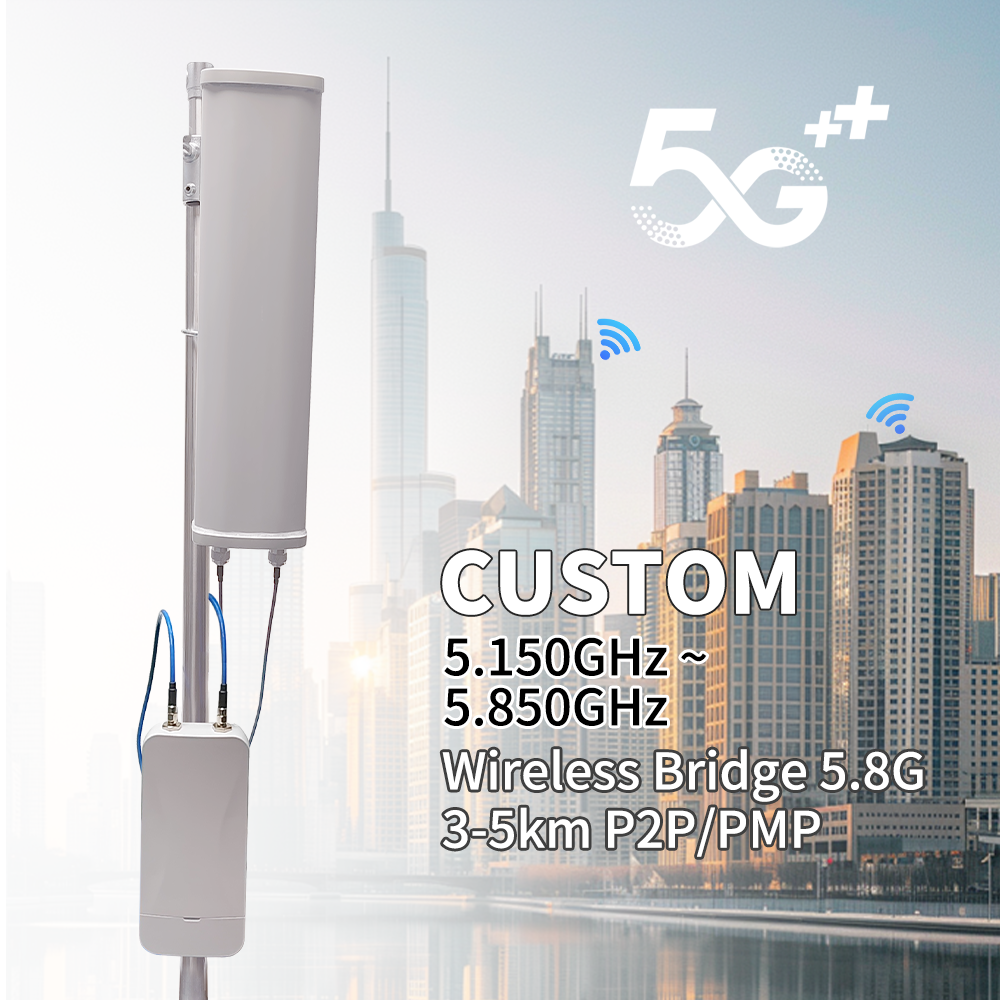
In modern network deployment, especially in scenarios where wired cabling is difficult or costly—such as remote mountainous areas, outdoor industrial sites, or ship communications—wireless bridges have become an indispensable core device. Unlike traditional wired connections, wireless bridges establish point-to-point or point-to-multipoint wireless links, enabling stable data transmission over long distances without the need for cumbersome cable laying. This article will delve into the working principle, core advantages, typical application scenarios, and key selection points of wireless bridges, helping you understand how this device optimizes network connectivity.
A wireless bridge is a network device that connects two or more separate network segments through wireless signals, essentially acting as a “wireless cable” to transmit data between different networks. It operates by receiving wired network signals from one end, converting them into wireless signals (usually 2.4GHz or 5GHz, or even broadband frequency bands like 1710-2700MHz for long-distance transmission), and then transmitting them to another wireless bridge at the receiving end, which converts the wireless signals back into wired signals to connect to the target network. This working mode not only avoids the high cost and long construction period of wired cabling but also ensures stable and efficient data transmission over distances of several kilometers to tens of kilometers.
The core advantages of wireless bridges are reflected in their long-distance transmission capability, high stability, and strong adaptability. First, high-gain antennas (such as 14dBi sector antennas) are usually equipped to enhance signal strength and extend transmission distance, supporting stable communication up to 5-10km or even farther under ideal conditions. Second, they adopt advanced anti-interference technologies, such as dual polarization design, which can effectively reduce signal fading and interference from external environments, ensuring low packet loss and low latency during data transmission. Third, wireless bridges are designed with industrial-grade durability, featuring dustproof, waterproof, and anti-corrosion properties, making them suitable for harsh outdoor environments such as high temperatures, low temperatures, and high humidity.
Typical application scenarios of wireless bridges cover multiple fields. In outdoor communication projects, they are widely used for signal transmission between base stations, connecting remote mountainous areas, rural regions, and urban networks to solve the problem of difficult wired coverage. In industrial scenarios, wireless bridges connect scattered industrial equipment, monitoring systems, and control terminals in factories or industrial parks, realizing wireless interconnection of the industrial Internet of Things. In special environments such as ship communications and outdoor adventures, they provide stable network support for mobile devices and communication equipment, ensuring uninterrupted data transmission. Additionally, in point-to-point wireless backhaul projects, wireless bridges replace traditional optical fibers to establish high-speed backbone links, reducing deployment costs and improving network flexibility.
When selecting a wireless bridge, there are several key factors to consider. First, the frequency range and transmission distance should be matched with the actual application scenario—for long-distance transmission (5-10km), broadband wireless bridges supporting 1710-2700MHz frequency bands are preferred; for short-distance indoor or small-area outdoor use, 2.4GHz or 5GHz bridges are more suitable. Second, pay attention to the gain and beamwidth of the antenna: higher gain means longer transmission distance, while reasonable beamwidth (such as 75° horizontal beamwidth) can improve signal coverage and anti-interference ability. Third, check the interface type and compatibility to ensure it can connect with existing network devices (such as routers, switches, and base stations) and support common network protocols. Finally, prioritize products with strict quality testing and certifications (such as ISO, RoHS) to ensure long-term stable operation in harsh environments.
In conclusion, wireless bridges play an irreplaceable role in long-distance wireless connectivity, breaking the limitations of wired cabling and providing flexible, efficient, and cost-effective network solutions for various industries. Whether it is outdoor coverage, industrial interconnection, or special environment communication, wireless bridges can meet the diverse needs of network deployment and become a key force in promoting the development of wireless networks.
发表回复
要发表评论,您必须先登录。